
Kia ora EDANZ community,
Mānawatia a Matariki! As we pass the middle of the year, it feels like the right moment to pause, take stock, and look ahead, just as Matariki invites us to do.
Our Te Whatu Ora-funded projects continue to keep us busy. With the call-back programme running smoothly, our focus now is on resource refresh and continuing to support our volunteers. None of this mahi would be possible without them, and without you, our community.
This month we are turning our attention to a topic that comes up in almost every conversation we have with families: co-parenting through an eating disorder. Whether you are parenting under one roof, as a single or a blended family, or across two households, being on the same page as your co-parent is one of the most powerful tools you have. Read on for why it matters so much, and for some practical ways on how to make it happen.
Ngā mihi nui,
Andrea Bonetto, Chairperson

Co-parenting
We often describe recovery as a team effort, and at the heart of that team are the caregivers, doing the day-to-day work at home. When they are pulling in the same direction, the whole household feels steadier. When they are not, the eating disorder notices.
Eating disorders are remarkably good at finding cracks. If one parent holds a boundary at the table and the other softens it, the illness will make straight for the softer side. If dad says the snack is non-negotiable and mom quietly lets it slide (or vice-versa), the message the eating disorder hears is that everything is negotiable. This is not because either parent is doing anything wrong. Both are acting out of love, one trying to hold the line, the other trying to reduce distress. But an eating disorder will take advantage of even the tiniest difference between caregivers and work to widen it, playing one parent off against the other until the adults are distracted, arguing with each other, instead of standing together against the illness.
Being on the same page does not mean agreeing about everything. It means agreeing on the things that matter most: meals are not negotiable, food and love are medicine, and the eating disorder does not get a vote. It means deciding together, in advance, how meals and snacks will run, what the expectations are, and what happens when things get hard. And crucially, it means having your disagreements away from your child. In private, debate, question, and negotiate with each other as much as you need, but again, do it in private, and then present the decision with one voice.
This matters just as much, and often more, for parents who are separated or divorced. An eating disorder does not take weekends off, and it will happily thrive in the space between two households with two different sets of rules. Co-parents who may find communication difficult in other areas of life often discover that the eating disorder is the one thing they can genuinely unite on. You do not need to agree about everything else. You do need to agree about this. Consistent meal plans, consistent expectations, and honest handovers between houses tell the eating disorder there is nowhere to hide.
Presenting a united front is not just a tactic, it is also a message to your child. Underneath the illness, your child is watching. Two parents standing calmly and firmly together says, "You are safe. We have got this. You do not have to fight this alone, and, above all, recovery is not negotiable."

Agree to a plan together and stick with it
- Agree the plan before the meal, not during it: Decide together, ahead of time, what will be served, what the expectations are, and how you will respond if the eating disorder pushes back. The dinner table is not the place to discover you have different views. If something unexpected comes up mid-meal, back each other up in the moment and talk it through afterwards, in private.
- Never let the eating disorder referee your disagreements: You will not always agree, and that is completely normal. But if your child hears you contradicting each other about food or boundaries, the eating disorder will use that. Have a simple rule: united in front of the kids, honest debate behind closed doors. Some parents find a code word or a quick glance helpful, a signal that means "let's talk about this later".
- Schedule a regular co-parent check-in: Set aside a regular time (it doesn’t have to be long), in person or a phone call between households to review how meals went, what worked, what did not, and what is coming up. Making it routine means small differences get sorted before they become big ones, and it gives you both a place to offload that is not the dinner table or in front of the kids.
- For separated co-parents, make handovers count: A debrief over handover between households can make an enormous difference: what was eaten, how meals went, anything the treatment team has changed. Keep it about the illness, not about old grievances. A shared notebook, app, or short email works well if conversations are hard. Whichever way it happens, the goal is: same food, the same expectations, and the same calm consistency in both homes.

Parents united against the eating disorder: what the evidence says
Does standing together as parents actually make a difference, or does it just feel like it should? Researchers in Sydney set out to answer this (Ellison et al., 2012), following 59 young people through 20 sessions of family-based treatment (FBT), to see what predicted recovery in anorexia nervosa.
When parents were united, their children did better and gained more weight, the key early sign of recovery. Even more so, unity was what made everything else possible: parents who stood together were far more able to take charge of eating and hold the line at mealtimes. And this was true across all kinds of families, including re-partnered and single-parent households.
Newer research backs this up. A 2025 review of 39 studies (McCord et al.) found that when one parent lacked the other's support, they struggled to see meals through. For separated parents, keeping things consistent across both households is what supports renourishment. The united front matters just as much when it has to stretch across two households.
The takeaway for whānau is hopeful and practical: being on the same page as your co-parent genuinely helps your child recover, and it is something you can start working on today.
Ellison, R., Rhodes, P., Madden, S., Miskovic, J., Wallis, A., Baillie, A., Kohn, M., & Touyz, S. (2012). Do the components of manualized family-based treatment for anorexia nervosa predict weight gain? International Journal of Eating Disorders, 45(4), 609–614. https://doi.org/10.1002/eat.22000
McCord, A., Rice, K., & Rock, A. (2025). Caregiver factors influencing family-based treatment for child and adolescent eating disorders: a systematic review and conceptual model. PeerJ, 13, e19247. https://doi.org/10.7717/peerj.19247

This shows how wonderful our volunteers are:
"I just wanna say a big thank you. You were so kind and very helpful, it makes me so happy and grateful that I got to talk to someone like you about a situation that’s not so easy. There’s not a lot of genuine help or kindness these days even for things as sensitive as eating disorders. The system is broken and hard to navigate. So, thank you so much for making it just a little easier and less daunting."
– South Island parent
If EDANZ has helped you or you have any suggestions on what we can do better, please email us at: info@ed.org.nz
We’d love to hear from you.

Please make a donation today
and have real impact on the work we do.
Thank you to everyone who has contributed financially. Whether it is a one-off or regular donation, your support makes a real difference.

Join the EDANZ Helpline: Supporting others on the journey
The EDANZ helpline is a vital lifeline for families navigating the complexities of eating disorders. We are currently looking for volunteers to join us in providing support and guidance. If you have supported a loved one through an eating disorder and feel ready to give back, your lived experience is incredibly valuable. By joining our team, you can offer hope and understanding to those who are now walking the path you once travelled.
We welcome any amount of time you can offer, and every hour of support makes a profound difference for our community. Your unique perspective allows you to connect with families in a way that truly matters. If you would like to help us ensure that no one faces this challenge alone, please get in touch with us. We would love to discuss how you can contribute to this rewarding mission.

Upcoming support group meetings
EDANZ believes parents/carers have unique abilities to support one another and we hold regular meetings to which you are warmly invited. Currently, we're joining together around the country on the first Wednesday of every month over Zoom.
If you would like to participate in a virtual support group, please RSVP to info@ed.org.nz and we'll send you the link.
Upcoming meetings:
- Wednesday, 5 August at 8pm
- Wednesday, 2 September at 8pm
More information can be found on our website Parent/Carer Support Groups page
Remember: EDANZ helpline is open throughout the year, including holiday periods. Please don’t hesitate to contact us at info@ed.org.nz or leave a message on the phone 0800 2 EDANZ and we will get back to you as soon as we can. If you are concerned about the safety of someone, please ring 111 or go to the Emergency Department of your nearest hospital.

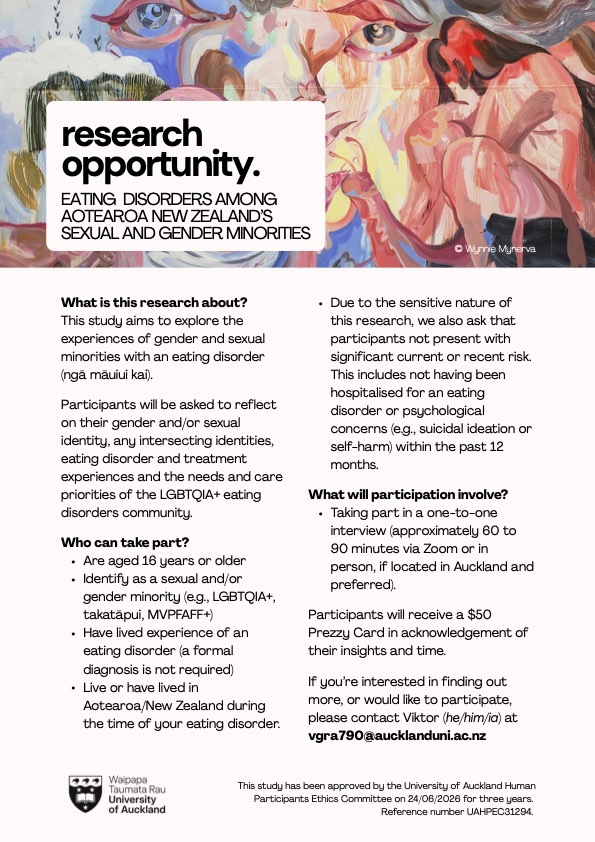
Email Viktor to find out more or participate: vgra790@aucklanduni.ac.nz
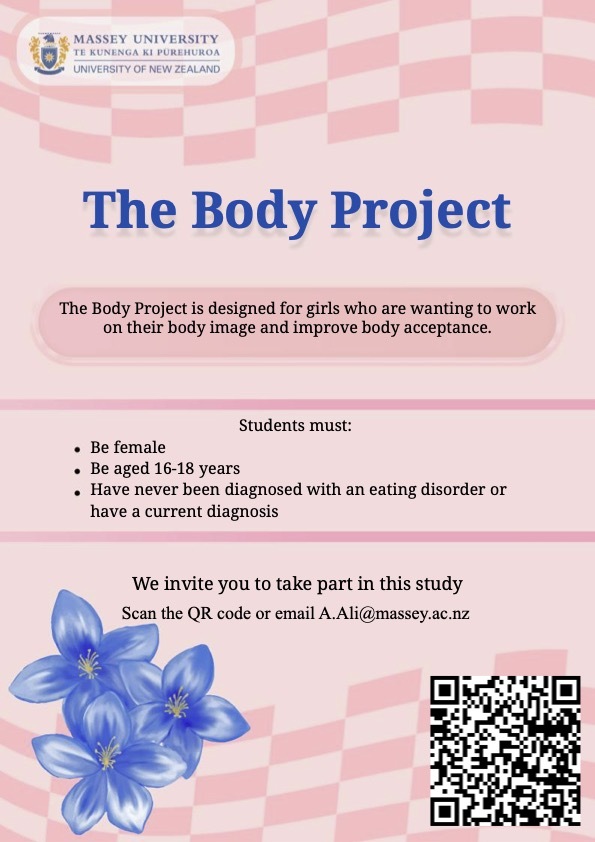
Email A.Ali@massey.ac.nz
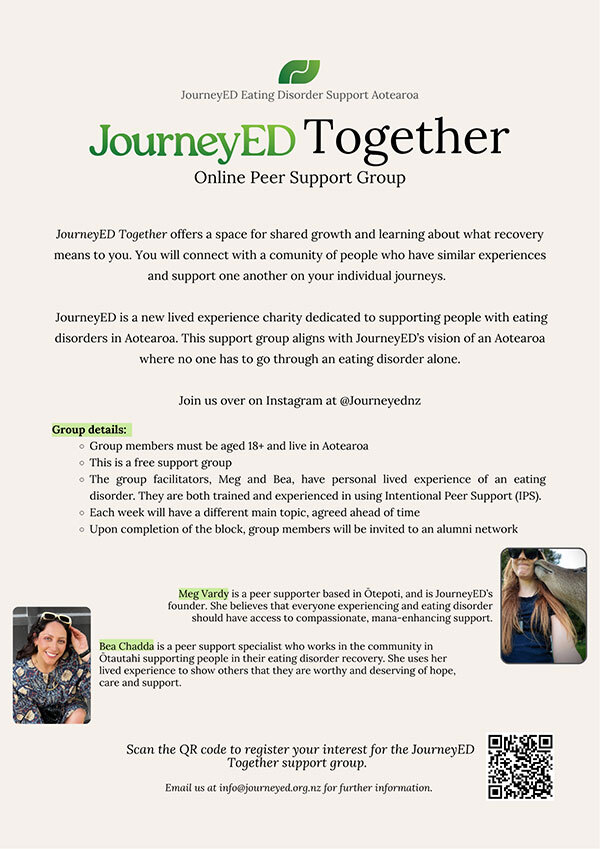
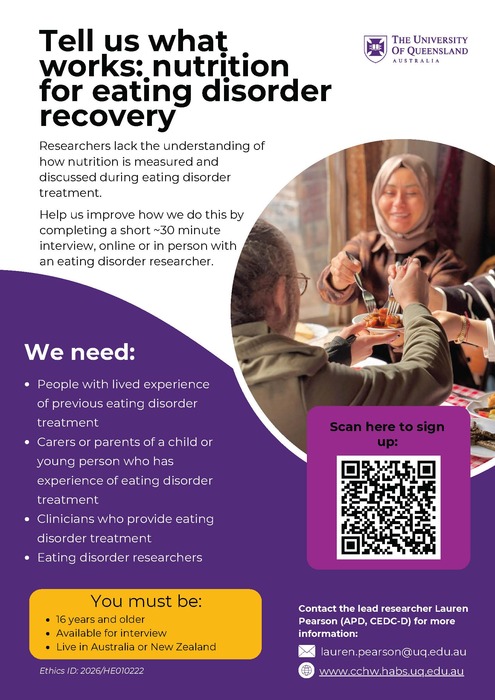
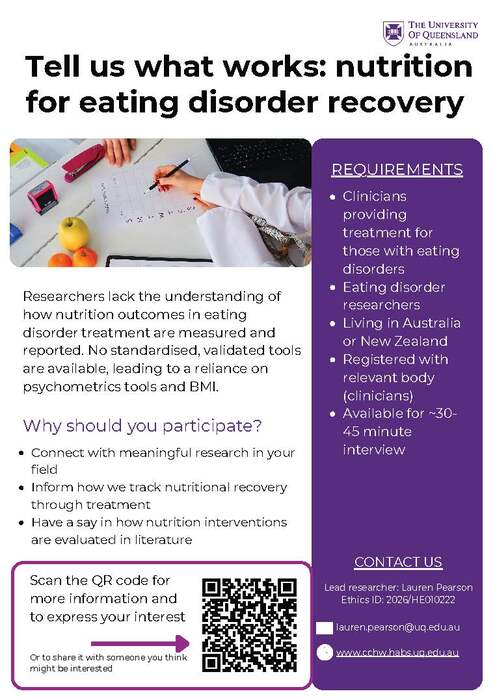
Participants needed for Eating Disorder Nutrition Research