


About EDANZ and Eating Disorders Down Under
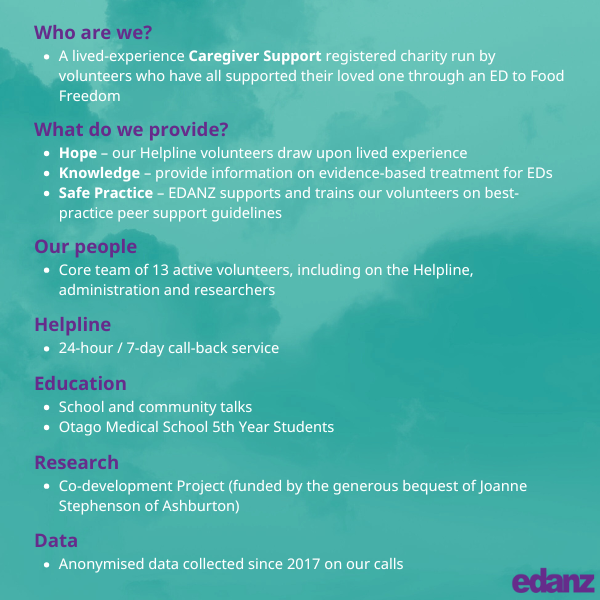
Our role here at EDANZ is to support the caregivers of someone experiencing an eating disorder – most of you reading this newsletter will know that already, however I’d like to explain a little more what that support entails.
What EDANZ does
Our main focus is and always will be to provide direct support to families when an eating disorder has entered their home. We have a callback service Helpline, accessible 24/7. That is to say, we have volunteers rostered on to check the voicemail, emails and contact site who then reply to the queries. We also have volunteers checking the website, updating our social media, fundraising, advocating on behalf of the people we serve, to improve services to those affected by an eating disorder and their families. We connect with Te Whatu Ora Eating Disorder Services, private practices and other Non-Government Organisations in the sector. Most of our volunteers work full time and/or are looking after their own families, and all of our people volunteer at EDANZ in their spare time. Phew, what a mouthful (please excuse the reference)!
Some recent stats
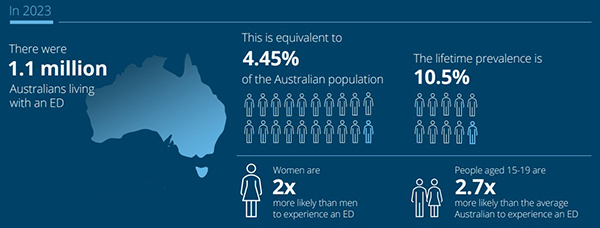
Australia’s Butterfly Foundation published a report last year, Paying the Price Report 2024, which revealed a 21% increase in prevalence and a 36% increase in economic cost of eating disorders since 2012. Alarmingly, the evidence shows 4.5% of the population are currently living with an eating disorder and 10.5% of people experience an eating disorder in their lifetime. Admittedly, that information is drawn from the Australian population, however, if we were to assume New Zealand could be similar, it means roughly 225,000 people in New Zealand are experiencing an eating disorder right now.
Never downplaying the anguish and torment affected individuals experience themselves, an eating disorder has an impact on the many family members as well. Those are the people we are endeavouring to support and those are the people who are front and foremost in our minds when we interact with politicians, the media, clinicians and academics.
Help us to help more
So, yes, after all that explaining, we’re going to ask for money once again. In response to requests from our community, we recently set up a system whereby regular monthly donations can be made through our website. In a few simple steps, and starting from less than the price of a coffee a week, you can sign up to donate monthly to help us keep EDANZ going. The money received will mean we can continue all the services mentioned above, plus any extra training and conferences our volunteers may attend. Upskilling and learning how to best work for the people we serve is so important to us.
Thank you so much to those who have already stepped up to give us peace of mind with a monthly donation. Of course, we’re also grateful for one-time donations. We know times are tough out there at present. But with just a little help from many, we could do so much more.
PS: With the end of the tax year approaching, remember that donations to EDANZ are tax deductible :-)

Butterfly Foundation
Here is the full report from the Butterfly Foundation published this time last year with all the statistics found through their research
Netsafe
We have an exciting new resource for families and schools in New Zealand too. Netsafe have published a "Body Image and Social Media Toolkit": Containing information, advice and practical tips, this toolkit helps to explain how social media platforms may play a role in how young people feel and think about their bodies, and how they can take back control of what appears in their Instagram feeds.
https://issuu.com/netsafe/docs/body_image_300125r6
Wharaurau
Wharaurau have launched a number of wonderful resources with a particular Aotearoa New Zealand focus. A stand-out poster which was authored by Genevieve Mora and Adam Whiskin and illustrated by Jessica Hinerangi (Māori Mermaid), offers practical tips and guidance on how to support someone experiencing an eating disorder:
https://www.wharaurau.org.nz/all-resources/tips-on-how-to-support-a-person-with-an-eating-disorder
All the other resources on the Wharaurau website are here:
https://www.wharaurau.org.nz/all-workstreams/eating-issues-eating-disorders