
IN THIS ISSUE...
- Message from the Chair
- Topic of the Month: GP Visits
- Tip of the Month
- Research Corner
- Feedback Corner
- Community Announcements
- Upcoming EDANZ support meetings
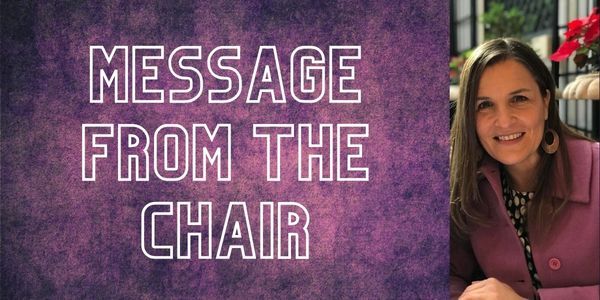
My name is Andrea Bonetto, and I’m deeply honoured to have been invited to serve as your new EDANZ Chairperson. Having experienced an eating disorder myself in my teens and cared for a loved one through theirs, I hope this lived experience and the perspectives gained will help me serve this community with empathy and understanding.
If you’re reading this newsletter, you may be supporting someone who is facing or has faced an eating disorder. You are the reason EDANZ exists. We’re here to advocate for you, to share evidence-based information and practical strategies, and most importantly, to listen and offer support. Please know that you don’t have to go through this alone. Reach out. We are here for you.

GP Visits
Visiting a GP because you are worried your child might have an eating disorder is often an anxious and frustrating experience. Most parents arrive exhausted after weeks of poor sleep and arguments over food, sensing something is wrong but unsure how serious it is or how to explain it. The consultation can feel rushed or awkward since eating disorders are not always visible through weight or appearance. Parents often struggle to describe subtle changes such as mood swings, food rituals, and secretive behaviour, while hoping the GP recognises the urgency.
Some doctors respond with kindness, arranging tests or referrals to eating disorder services. That validation can bring a little relief. Others, however, focus mostly on BMI or visible weight loss, which can be misleading in early or atypical cases. Families often leave feeling unheard or embarrassed for “overreacting”. It helps to remind the GP that eating disorders are about malnourishment, not weight. A person can look healthy and still be dangerously unwell.
Despite the stress, that first GP visit is a crucial step, marking the shift from confusion to action. Long waits for treatment and limited services can add to the anxiety. Do not lose hope if you are on a waiting list for services. There is much you can do, since most of the recovery work happens at home. Begin with regular nutrition: three meals and three snacks, non-negotiable. It is hard, but it is the most powerful thing you can do, and EDANZ is here to support you.
Before your loved one’s first or next GP visit, take time to write down what has happened recently. Make a list of the behaviours that have changed (food, sleep, exercise, mood, relationships, etc). Sleep on it for a couple of days, reread it, and revise if needed. Sometimes it is difficult to talk about these issues with your loved one present, so email it to your GP before the appointment. If emailing is not possible, take the list with you and, at the beginning of the appointment, go in to see the GP by yourself, discuss your concerns, and then invite your loved one to join. Remember, there is no limit to what you can tell the doctor. The more information they have, the better their assessment and the better the outcome.

Managing patients with eating disorders: a qualitative study in primary care
Carrie Ashby and Jane Ogden
https://pubmed.ncbi.nlm.nih.gov/38688531/
This article shows that GPs want to help patients with eating disorders but face real limitations in the care they can provide. They receive very little training on eating disorders, and greater clarity is needed regarding referral processes.
“Thank goodness after my chat with EDANZ I got straight onto getting a GP appointment. I had my list to read to my doctor of what has been happening, which was such a helpful tip. Thanks so much is all I wanted to say. I am so very grateful that I had this organisation to turn to in such unknown territory. Thanks so much.”
– Anonymous mum

Participate in research
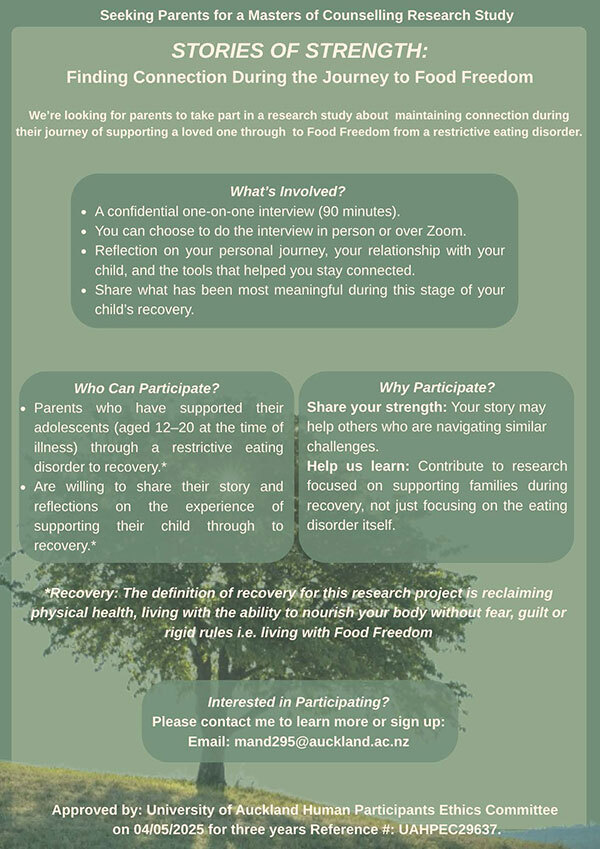
Megan is doing her master’s degree at Auckland University and is looking for parents to take part in a research study about maintaining connection while supporting a loved one through a restrictive eating disorder.
Contact Megan at mand295@aucklanduni.ac.nz

Free Community Event in Tauranga
Join those at https://www.redefinedcoaching.co/ for a night of raw stories and shared hope. See pamphlet for more details.
Naked Faces
Naked Faces is a public art exhibition that honours those who have lived through eating disorders — not just individuals but also the families who stood by them. It is a space to unveil truth, celebrate resilience, and redefine beauty through raw, unfiltered portraits: no makeup, no filters, no Photoshop, no AI. Show the world what real healing looks like and help shift the narrative from shame to self-expression and from isolation to belonging.
If you’d like to be one of the 99 models featured in this exhibition, please contact Stephanie at 022 540 0309.
Upcoming support group meetings
EDANZ believes parents/carers have unique abilities to support one another and we hold regular meetings to which you are warmly invited. Currently, we're joining together around the country once a month thanks to videoconferencing technology.
If you would like to participate in a virtual support group, please RSVP to info@ed.org.nz and we'll send you the link.
Upcoming meetings:
- Wednesday, 5 November at 8pm
- Wednesday, 3 December at 8pm
More information can be found on our website Parent/Carer Support Groups page
Remember: EDANZ helpline is open throughout the year – please don’t hesitate to contact us at info@ed.org.nz or leave a message on the phone 0800 2 EDANZ and we will get back to you as soon as we can. If you are concerned about the safety of someone, please ring 111 or go to the Emergency Department of your nearest hospital.

Please make a donation today
and have real impact on the work we do.
We are a fully volunteer association and receive no contract funding. Whether it is a one-off or regular donation, your support makes a difference.