
IN THIS ISSUE...
- Message from the Chair
- How to finally move away from black and white thinking
- Perfectionism's role in developing an eating disorder
- Unrecognized eating disorders in boys and young men
- Research opportunity
- Upcoming EDANZ support meetings

Every time I sit to write this editorial it is raining! Or at least that’s what it feels like because it is raining today, and I think it was raining last month too. Of course, it’s not always raining, there are sunshiny days too, it’s just when we are inundated with rain it can feel like it’s always that way. Black and white thinking, all or nothing, always or never – that absolute and rigid way of thinking that an eating disorder can exacerbate; it is both a symptom of eating disorders and a trait amongst people who are vulnerable to eating disorders.
This month we have a couple of articles about all-or-nothing thinking and perfectionism, both of which are symptoms and traits that can accompany an eating disorder. We also have a thoughtfully written article about eating disorders amongst boys and young men. The article challenges the common misconception that eating disorders only affect girls and women.
Wishing you all a safe and steady August. I hope you and your loved ones can spend some time taking a wider view and live in the various shades of grey, even finding some blue-sky days.
Ngā manaakitanga
Megan

How to Finally Move Away from Black and White Thinking
Our first article gives some excellent advice on how to think between the spectrum of black and white, widening one’s approach to life. Three key points explored are:
- Taking a wider view
- Practising neutrality in our speech
- Building our own window of tolerance with discomfort
“We sometimes adopt it [rigid thinking] to help cope with feelings of anxiety, guilt, and shame when complex situations contain a great deal of nuance, which can be intimidating to decipher.”
Perfectionism's Role in Developing an Eating Disorder
Perfectionism is also one of those traits often associated with eating disorders. Perhaps perfectionism is a type of black and white thinking, or at least related to it. Perfectionism is “characterised by a relentless pursuit of high standards and the need for flawless performance in all areas of life.” This next article explores the dark side of perfectionism, how to break the pattern of perfectionism, and how to practise compassion in the face of it.

Unrecognized Eating Disorders in Boys and Young Men
Finally, another article which challenges the stereotypes and myths associated with eating disorders.
“Symptoms of eating disorders may be different in males, but treatment is often the same as that for women.”
Opportunity to Participate in Research
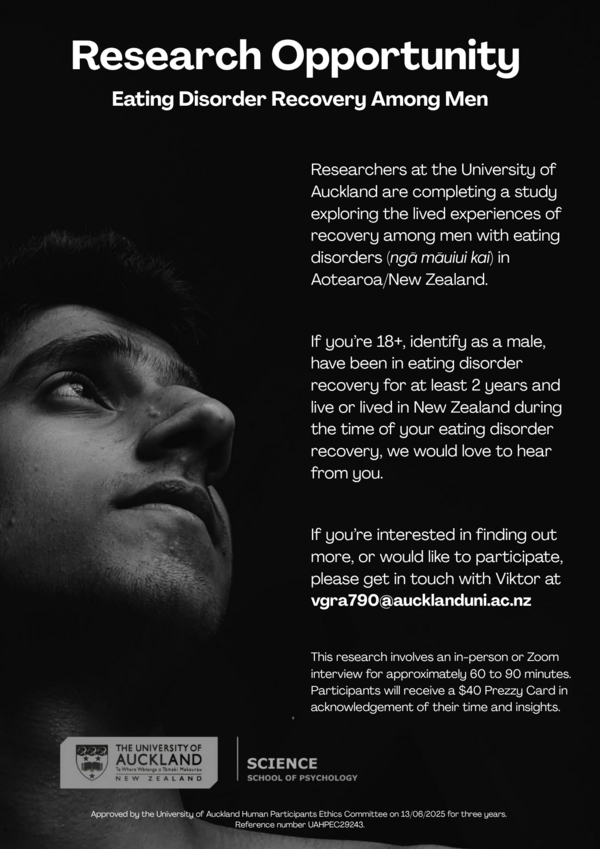
The EDANZ community is invited to take part in a new research opportunity that will investigate eating disorder recovery among men.
If you...
- Are aged 18 or older
- Identify as male (cisgender or trans-masculine)
- Have lived experience of an eating disorder
- Have been in recovery for at least two years
- Currently live in New Zealand, or lived here during your recovery journey
A formal diagnosis is not required.
Please also pass this information on to anyone you know who may be eligible.
Anyone keen to participate is welcome to contact Viktor directly at vgra790@aucklanduni.ac.nz.

Upcoming support group meetings
EDANZ believes parents/carers have unique abilities to support one another and we hold regular meetings to which you are warmly invited. Currently, we're joining together around the country once a month thanks to videoconferencing technology.If you would like to participate in a virtual support group, please RSVP to info@ed.org.nz and we'll send you the link.
Upcoming meetings:
- Wednesday, 6 August at 8pm
- Wednesday, 3 September at 8pm
More information can be found on our website Parent/Carer Support Groups page
Remember: EDANZ helpline is open throughout the year – please don’t hesitate to contact us at info@ed.org.nz or leave a message on the phone 0800 2 EDANZ and we will get back to you as soon as we can. If you are concerned about the safety of someone, please ring 111 or go to the Emergency Department of your nearest hospital.
"When I rang EDANZ, I found not only compassion and understanding on the other end of the phone, but someone who had been where I was, someone who knew what we were going through. They gave me practical help, information about the illness that had invaded our home and a way to kick it out."
Did you know EDANZ doesn't receive any regular funding? The EDANZ team are all volunteers who generously give their time to support families and the community.
Even a small donation from you will help us stay afloat.
We're so grateful to those who have already helped us financially this year... and those who continue to do so on a regular basis.