
IN THIS ISSUE...
- Message from the Chair
- Topic of the Month: What does EDANZ do?
- Tip of the Month: Government Financial Support for Eating Disorder Recovery you might be able to access
- Research Corner: Psychosocial and financial impacts for carers of those with eating disorders in New Zealand
- Feedback Corner
- Join the EDANZ Helpline: Supporting others on the journey
- JourneyED Together: New Online Peer Support Group for people with eating disorders in Aotearoa
- Upcoming EDANZ support meetings

Greetings from all of us at EDANZ.
Exciting news to share this month!
EDANZ has always subsisted on the tireless dedication of our volunteers and the generosity of our donors. Last year, Health New Zealand | Te Whatu Ora announced a new strategy for eating disorders including funding for peer support. We are thrilled to be able to share that our application for funding has been approved. For the first time in 23 years EDANZ has secured government funding! This is a monumental milestone for our organisation and a turning point that will allow us to expand our mahi across Aotearoa.
We offer a heartfelt thank you to Minister for Mental Health Hon Matt Doocey, our former volunteer and Chairperson Megan Tombs, Cathy McGachie from Te Whatu Ora, and all those behind the scenes who worked so hard to make this happen. We are incredibly grateful for this support. Thank you all!
Time to get to work.
Andrea Bonetto – Chairperson

What does EDANZ do?
At EDANZ, our mandate is two-fold:
- We provide vital support to the whānau of those experiencing an eating disorder.
- We work to educate and advocate for better understanding and treatment of eating disorders across Aotearoa.
With the new funding we will be able to expand on that support and education.
Expanding Direct Support with a Call-Back Programme
Until now, our volunteers have provided information, strategies and a listening ear through initial calls and emails. However, we lacked the capacity to follow up. Our new Call-Back Programme changes that. We can now offer weekly follow-up calls for four weeks, allowing us to walk alongside families during the critical first month of their journey, rather than just at the moment of crisis.
Broadening Education & Training
For several years, EDANZ has led eating disorder education sessions for Otago medical students at Wellington Hospital. These sessions, up to now, have been the only specific training these students receive on eating disorders. We are now expanding this programme to include:
- Allied Health Students: Providing this essential training for future nurses, dietitians, psychologists, etc.
- Health Professionals: Upskilling those already in practice.
- Community & Schools: Taking our education programmes directly into high schools and community organisations.
The Impact of Early Intervention
Our goal is to foster early identification and diagnosis. By supporting and informing whānau and educating those on the frontline, we can reduce the long-term suffering of individuals and their families. As research shows, early intervention not only saves lives but also creates significant cost savings for the wider healthcare system.
These projects are just the beginning. We look forward to keeping you updated as we translate this funding into meaningful, life-changing action for all those affected by eating disorders across Aotearoa.

While on the topic of funding:
Government Financial Support for Eating Disorder Recovery you might be able to access
It is absolutely true that refeeding is a medical process, not just "eating more” and the financial strain on families can be immense. Between specialised groceries, high-calorie supplements, and constant travel to appointments, the costs add up quickly.
Refeeding is a demanding medical necessity that often comes with significant costs. Some health practitioners might not be aware that in New Zealand, Work and Income (MSD) offers specific allowances to help ease this burden.
For Children and Teens (Under 18)
If you are caring for a child with an eating disorder, you may be eligible for two different types of support. You can often receive both at the same time.
1. Child Disability Allowance:
This is a set payment made to the main carer of a child who requires constant care and attention due to a serious medical condition.
- $62.43 per week.
- This is not income-tested. Your assets and earnings do not affect your eligibility.
- It is paid every two weeks and is generally non-taxable and will not affect any other benefits you might be receiving.
- How to apply: Complete your and your child’s information on the Child Disability Allowance Application. Your doctor or health practitioner must complete the medical certificate section to confirm the level of care required.
- Submit through the website or visit your local MSD location.
For more information visit:
https://www.workandincome.govt.nz/products/a-z-benefits/child-disability-allowance.html
2. Disability Allowance
Unlike the fixed allowance above, this covers actual ongoing costs related to the illness (e.g., specialised high-calorie foods, prescriptions, or travel to therapy).
- Up to a maximum of $82.85 per week.
- This is income-tested. Your total household income must be below a certain threshold to qualify.
- What it covers: Extra food costs (specifically "Special Food" required for refeeding).
- Travel costs to doctors, therapists, or hospitals.
- Prescriptions and medical fees.
How to apply: Visit the MSD Disability Allowance page. You will need your health practitioner to list the specific extra costs (like "Special Food") on the medical certificate.
Support for Young Adults (16+) and Carers
If the health condition is severe and expected to last for a long period, there are more comprehensive options:
Supported Living Payment
- For the Individual: If a person aged 16+ is unable to work more than 15 hours a week due to their condition, they may qualify for this as their main income.
- For the Carer: If you are providing full-time care at home for someone who would otherwise need hospital-level care, you may be eligible for the Supported Living Payment for Carers.
Important Note: This is for information purposes only. Always check with your health practitioner, MSD or at a Work and Income service centre to see what you might qualify for.
Psychosocial and financial impacts for carers of those with eating disorders in New Zealand
Lois J Surgenor et al., 2022
https://pubmed.ncbi.nlm.nih.gov/3529210
When discussing funding and costs, we must acknowledge the immense personal and economic toll an eating disorder takes on a family. A 2022 New Zealand study by Surgenor et al. highlights the heavy psychosocial and financial burdens placed on carers. Because the public health system is often difficult to navigate, nearly half of the families surveyed felt compelled to fund private treatment themselves, despite lacking insurance. These out-of-pocket costs, paired with lost wages and reduced productivity, create a financial deficit that can take years to recover. Beyond the money, the constant stress undermines the carers' mental well-being and places a significant strain on family relationships. Ultimately, this research identifies a critical gap in the New Zealand healthcare system, where families are left to shoulder a profound burden without adequate official support.
During April, we conducted a soft launch of our call-back programme. For us at EDANZ, it has been so rewarding and incredibly fulfilling to witness these families move from that initial point of crisis toward gaining the information and confidence they need to support their loved ones.
The following feedback from our programme highlights the impact of this newly available support:
“For us it has been a lifeline that we are so grateful for. It provided us with information that we needed (and didn’t know we were missing) during the most stressful time in our lives. Your volunteer’s availability was super helpful as we had no one else we could talk to (that knew about eating disorders) at the times we really needed it. Your volunteer’s knowledge of the system and how it works was also invaluable. I can’t think of anything you could have done better at all, and we will always be grateful.”
- North Island family
If EDANZ has helped you or you have any suggestions on what we can do better, please email us at: info@ed.org.nz
We’d love to hear from you.

Join the EDANZ Helpline: Supporting others on the journey
The EDANZ helpline is a vital lifeline for families navigating the complexities of eating disorders. We are currently looking for volunteers to join us in providing support and guidance. If you have supported a loved one through an eating disorder and feel ready to give back, your lived experience is incredibly valuable. By joining our team, you can offer hope and understanding to those who are now walking the path you once travelled.
We welcome any amount of time you can offer, and every hour of support makes a profound difference for our community. Your unique perspective allows you to connect with families in a way that truly matters. If you would like to help us ensure that no one faces this challenge alone, please get in touch with us. We would love to discuss how you can contribute to this rewarding mission.
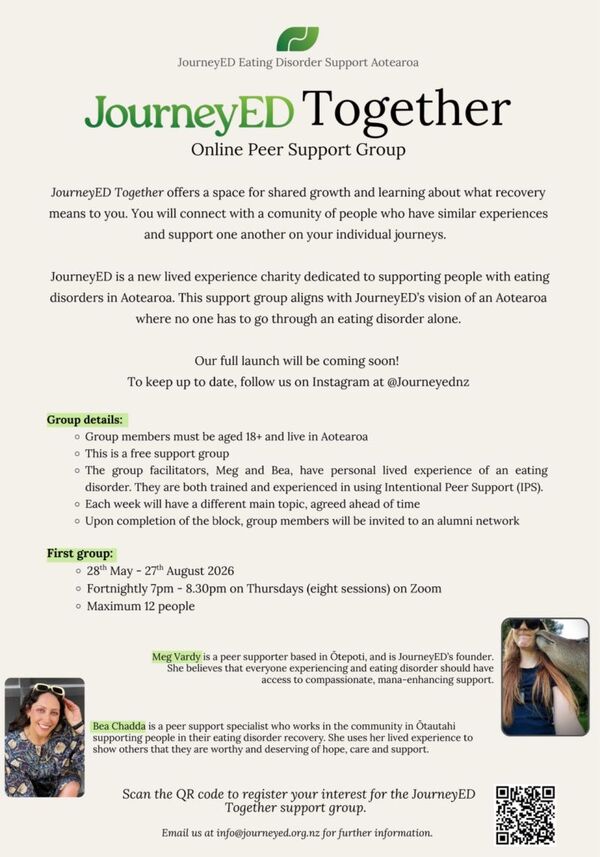
JourneyED Together: New Online Peer Support Group for people with eating disorders in Aotearoa
Upcoming support group meetings
EDANZ believes parents/carers have unique abilities to support one another and we hold regular meetings to which you are warmly invited. Currently, we're joining together around the country on the first Wednesday of every month thanks to videoconferencing technology.
If you would like to participate in a virtual support group, please RSVP to info@ed.org.nz and we'll send you the link.
Upcoming meetings:
- Wednesday, 6 May at 8pm
- Wednesday, 3 June at 8pm
More information can be found on our website Parent/Carer Support Groups page
Remember: EDANZ helpline is open throughout the year, including Christmas and New Year – please don’t hesitate to contact us at info@ed.org.nz or leave a message on the phone 0800 2 EDANZ and we will get back to you as soon as we can. If you are concerned about the safety of someone, please ring 111 or go to the Emergency Department of your nearest hospital.
Please make a donation today
and have real impact on the work we do.
Thank you to everyone who has contributed financially. Whether it is a one-off or regular donation, your support makes a real difference.