

Kia ora e te whānau,
Here at EDANZ we continue to work hard on our projects, based on supporting carers and educating our community on eating disorders.
We have, for over ten years, been delivering eating disorders education to Otago medical students at Wellington Hospital, training the next generation of doctors to recognise and respond to eating disorders early.
Through our new Te Whatu Ora funding, we are now able to expand our existing education programme. We can now offer education sessions to all tertiary students, community groups, and school staff and whānau. Our free sessions offer an opportunity to learn more about eating disorders and build your understanding of them.
If you know of an organisation that might benefit from a session, get in touch with us at info@ed.org.nz.
And don't forget, our education sessions are completely FREE!
Ngā mihi nui,
Andrea Bonetto, Chairperson

The genetics of eating disorders
Education has always been at the heart of what we do at EDANZ. The more we understand about eating disorders, the better equipped we are to support the people we love. This is exactly why new research matters so much to us: it doesn't just add to the science; it changes how we see the illness itself. A research paper on the genetics of eating disorders (see our Research Corner below for more details) released last month is a powerful example of this.
Carers often ask our volunteers: "Did I cause this?" At EDANZ, our answer is, and has always been, a resounding “No.” This new research brought some of the strongest evidence yet for why. Eating disorders are among the most heritable psychiatric illnesses and understanding the biology behind eating disorders helps us support our loved ones more effectively, and just as importantly, it helps us understand that this was never our fault.
This doesn't mean environment and psychology don't matter. Genetics loads the gun; life experience, environment, and culture still help pull the trigger. What this research shifts is the starting point: these are biologically influenced illnesses, not failures of parenting or willpower.

Genetics you can't change, environment you can
The study above confirms something we've said for years: eating disorders run in families partly because of genes, and no parent can change a child's genetic risk. But genetics is only part of the picture. Families have real influence, and the evidence points to some practical, everyday choices:
- Watch the diet talk at home: Avoiding diets, weigh-ins, and labelling food as "good" or "bad", or “healthy” or “unhealthy” at home is one of the better evidence-backed steps a family can take.
- Reduce weight talk and weight-based teasing: Commenting on other people's bodies, including your own, is a habit worth breaking.
- Notice perfectionism early: Praising effort and process rather than results, and above all, normalising mistakes, helps counter perfectionism.
- Keep an eye on social media use: Regular, judgement-free conversation about what young people are seeing online tends to matter more than social media bans.
- Take anxiety and low mood seriously, early: in many cases, anxiety or low mood shows up well before the eating disorder does, and getting support for these early may help protect against it.
- Shift the focus off appearance: Redirecting praise toward what someone did, tried, or cares about, rather than how they look, is a small habit with real protective value.
None of this guarantees prevention, and if an eating disorder develops despite doing "all the right things," that is not a sign you did something wrong. The genetics research points to why. This list won't fully shield your loved one from an eating disorder, but it is where the evidence says your influence is real.
References:
National Eating Disorders Association, Causes & Risk Factors; DeCaro, S., Genetics & Eating Disorders: 10 Tips to Reduce Risk (Even If You Have a Family History), The Renfrew Center (2023).
Sources:
Causes & Risk Factors of Eating Disorders (NEDA)
Genetics & Eating Disorders: 10 Tips to Reduce Risk (Even If You Have a Family History) (The Renfrew Center, 2023)

New research: the largest genetic study of its kind
Genomic meta-analyses of binge-eating behavior and anorexia nervosa yield insights into the unique and shared biology of eating disorder phenotypes
Termorshuizen, J.D., Davies, H.L., Lee, SH. et al. Genomic meta-analyses of binge-eating behavior and anorexia nervosa yield insights into the unique and shared biology of eating disorder phenotypes. Nat. Mental Health 4, 1361–1377 (2026).
On 19 August 2026, an international team led by researchers at King's College London, the University of North Carolina, and Karolinska Institutet published the largest genetic study to date comparing binge eating and anorexia nervosa, in the journal Nature Mental Health. The study analysed DNA from close to 40,000 people with binge eating and around 25,000 people with anorexia nervosa, against more than 1.2 million people without an eating disorder.
A common misconception is that eating disorder genetics simply mirror body weight genetics. This isn't the case: the genetic variants linked to binge eating and to anorexia nervosa are largely distinct from those that influence how much a person weighs. The two conditions point in different biological directions, not to two points on one spectrum.
The study identified six genetic loci associated with binge eating and eight linked to anorexia nervosa (six confirmed from earlier research, two newly discovered). Binge eating's genetic markers were more closely tied to impulse-control traits and ADHD; anorexia nervosa's markers were more closely tied to obsessive-compulsive disorder, underlining that the two conditions run on different biological pathways.
"Eating disorders are not just about body weight," said principal researcher Lu Yi. "Many of the genetic variants associated with these conditions differ from the variants that influence how much a person weighs." ¹
There's a strong Aotearoa connection with this research too. The study included data from more than 500 New Zealand participants through the University of Otago. Associate Professor Jenny Jordan (Otago) said the results "help us understand both shared and distinct causes of these eating-related traits" and "may also help us develop more precise treatments targeting the specific biology of each condition." ²
The next phase of the research will draw on around 4,000 New Zealand participants.
You can read the whole research paper at:
https://doi.org/10.1038/s44220-026-00698-2
Quotes:
1) Iraola
Iribarren, M. Anorexia and binge eating: Genetic study reveals eating disorders go beyond body weight. Euronews, 25 August 2026. https://www.euronews.com/health/2026/08/25/anorexia-and-binge-eating-genetic-study-reveals-eating-disorders-go-beyond-body-weight
2) Otago researchers uncover genetic clues to eating disorders. University of Otago News, August 2026.
https://www.otago.ac.nz/news/newsroom/otago-researchers-uncover-genetic-clues-to-eating-disorders
Note:
This study was based on European ancestry data, though the anorexia nervosa finding was cross-checked against two East Asian ancestry studies and held up to them. The authors state that future work will expand into multiple diagnoses and global ancestries beyond this first analysis.

Our volunteers work incredibly hard to support carers, and we love hearing from you.
We receive such lovely feedback, and sometimes even just a short sentence from you can make it all worthwhile:
"Thanks so much for your reply. I really appreciate it more than you'll possibly realise."
It means so much to know that the mahi we do really does change people's lives. Please do let us know how we did, whether it's something we did that helped, or how we could do better.

Please make a donation today
and have real impact on the work we do.
Thank you to everyone who has contributed financially. Whether it is a one-off or regular donation, your support makes a real difference.

Join the EDANZ Helpline: Supporting others on the journey
The EDANZ helpline is a vital lifeline for families navigating the complexities of eating disorders. We are currently looking for volunteers to join us in providing support and guidance. If you have supported a loved one through an eating disorder and feel ready to give back, your lived experience is incredibly valuable. By joining our team, you can offer hope and understanding to those who are now walking the path you once travelled.
We welcome any amount of time you can offer, and every hour of support makes a profound difference for our community. Your unique perspective allows you to connect with families in a way that truly matters. If you would like to help us ensure that no one faces this challenge alone, please get in touch with us. We would love to discuss how you can contribute to this rewarding mission.

Upcoming support group meetings
EDANZ believes parents/carers have unique abilities to support one another and we hold regular meetings to which you are warmly invited. Currently, we're joining together around the country on the first Wednesday of every month over Zoom.
If you would like to participate in a virtual support group, please RSVP to info@ed.org.nz and we'll send you the link.
Upcoming meetings:
- Wednesday, 7 October at 8pm
- Wednesday, 4 November at 8pm
More information can be found on our website Parent/Carer Support Groups page
Remember: EDANZ helpline is open throughout the year, including holiday periods. Please don’t hesitate to contact us at info@ed.org.nz or leave a message on the phone 0800 2 EDANZ and we will get back to you as soon as we can. If you are concerned about the safety of someone, please ring 111 or go to the Emergency Department of your nearest hospital.

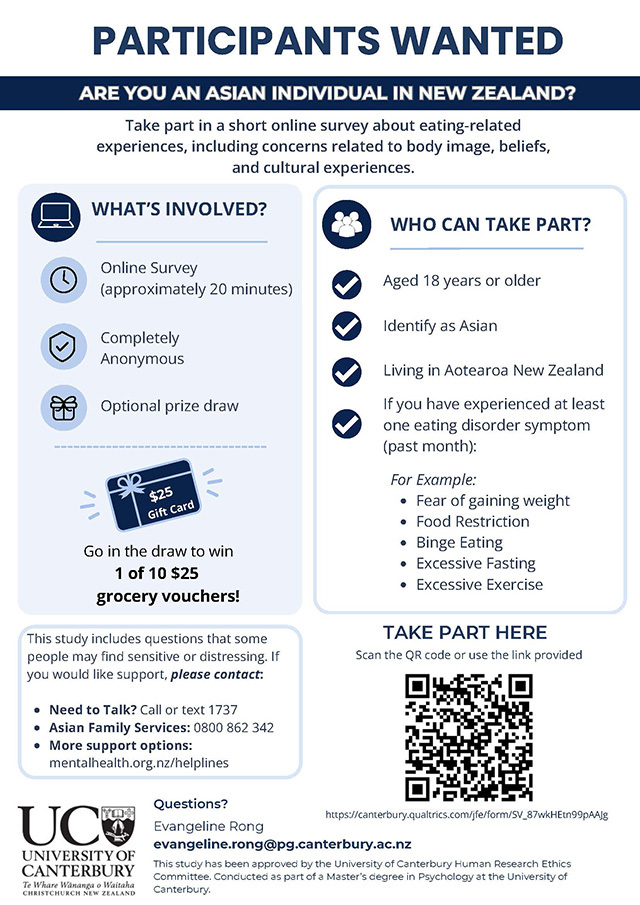
Contact: evangeline.rong@pg.canterbury.ac.nz
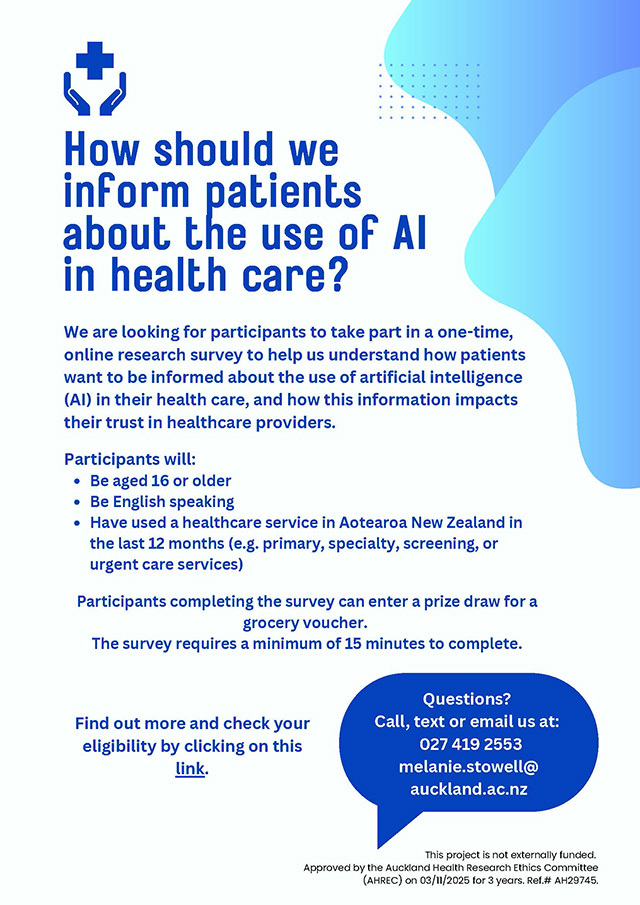
Contact: melanie.stowell@auckland.ac.nz
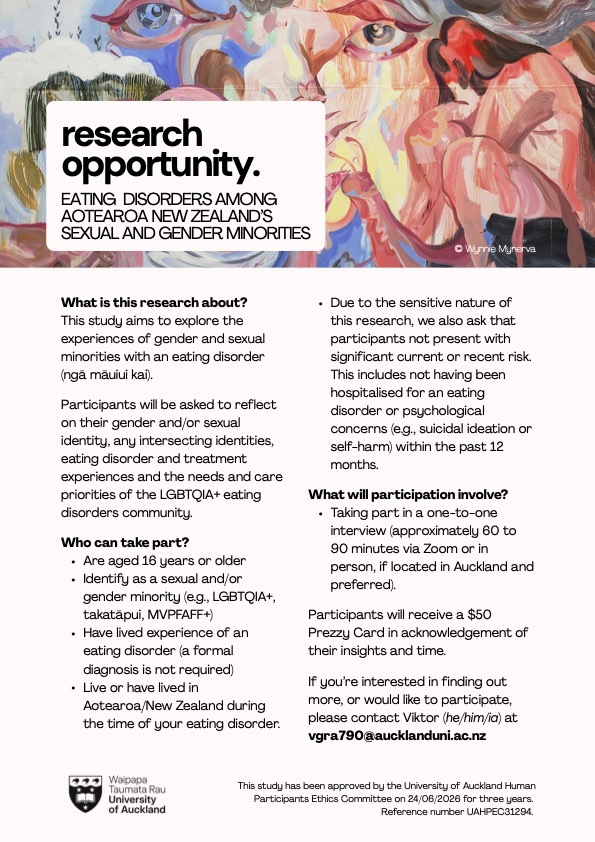
Email Viktor to find out more or participate: vgra790@aucklanduni.ac.nz
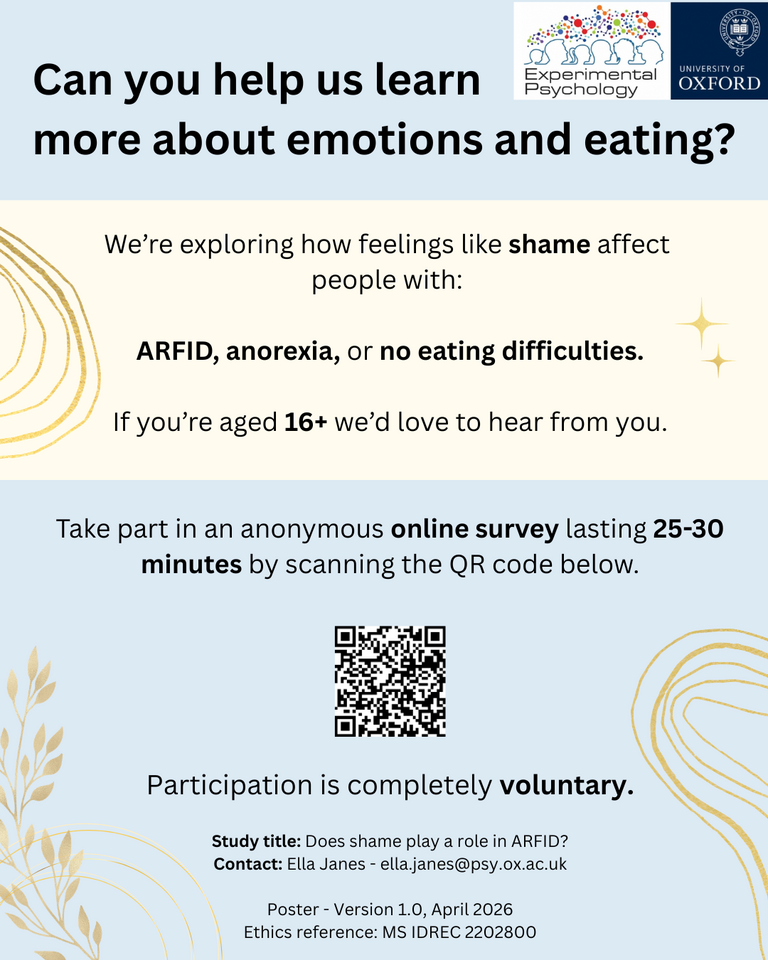
Contact Ella Janes: ella.janes@psy.ox.ac.uk
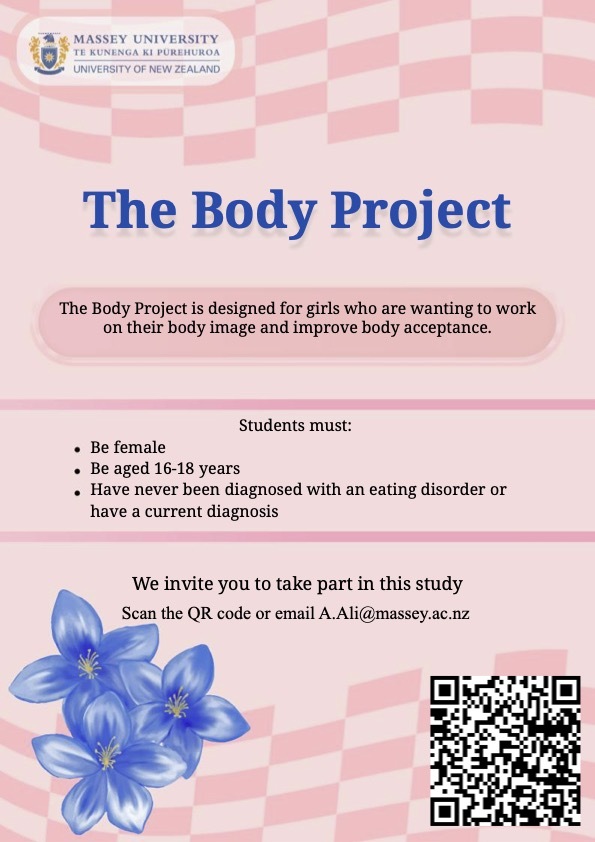
Email A.Ali@massey.ac.nz
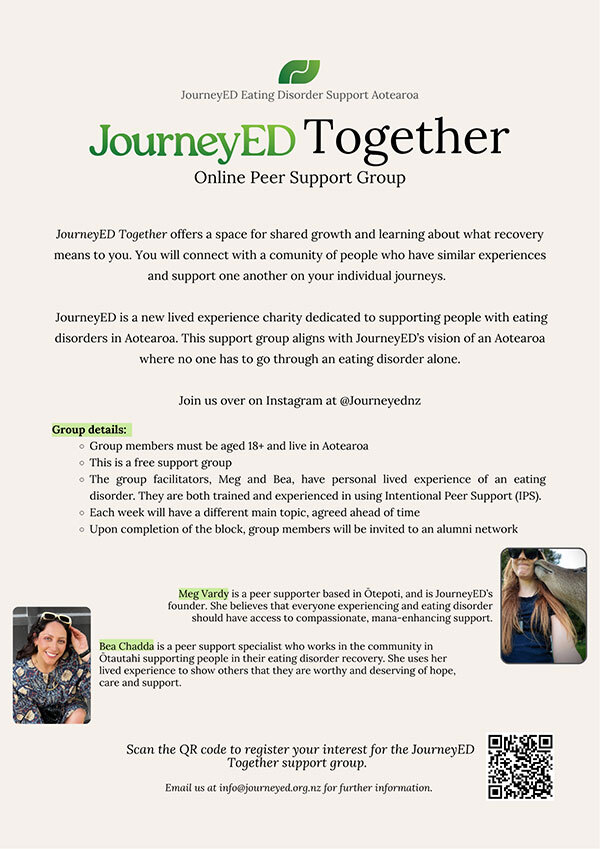
Participants needed for Eating Disorder Nutrition Research
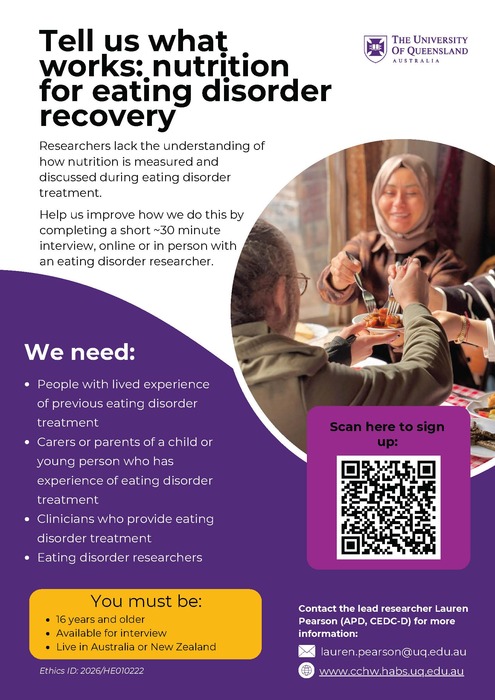
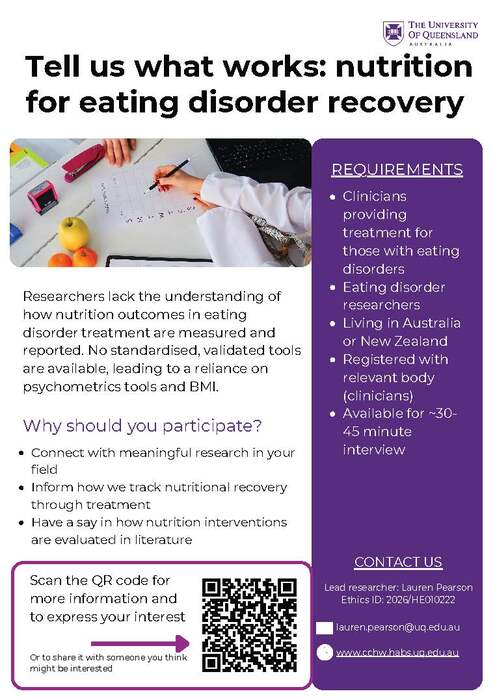
You are receiving this email because you opted in to receive information at an EDANZ event, a conference, via our website, or you are already an EDANZ mail recipient.
With spam controls increasing, to be sure to continue receiving EDANZ emails, we suggest you add info@ed.org.nz and info@edanz.nz to your address book. Thank you!
Our aim is to inform, not intrude. If you wish to be removed from our mailing list, please use the unsubscribe link at the bottom of this email.
Our mailing address is:
EDANZ Eating Disorders Association of NZ
1 De Havilland Road
Auckland 0616
New Zealand