

Kia ora e te whānau,
November is Movember, a month dedicated to raising awareness of men's health, including mental health. Eating disorders are often stereotyped as affecting only women and girls, but we know that is not the case at all. Eating disorders do not discriminate. People in the LGBTQIA+ community are at higher risk, and the number of boys and men living with eating disorders has grown considerably.
In honour of Movember, this month’s newsletter is dedicated to boys and men. To make sure we reflect their experiences from a their own perspective, I invited Viktor Gramov to write for us. Viktor is a wonderful, knowledgeable advocate in the eating disorder sector. Thank you, Viktor, for your contribution to our newsletter and for being such a great voice for boys and men affected by eating disorders.
Ngā mihi nui,
Andrea Bonetto, volunteer and Chairperson

Eating Disorders in Boys and Men
By Viktor Gramov, University of Auckland
In 2023, it was estimated that 5.5 million boys and men around the world were living with anorexia or bulimia¹, an increase of almost 75% since 1990. Yet, conversations across society, research and treatment environments have largely centred on girls and women. This focus has influenced how eating disorders are understood, recognised and treated, with research suggesting that men have an increased likelihood of having an undiagnosed eating disorder².
While boys and men experiencing disordered eating may show more commonly recognised signs, such as concerns around food and weight, research also highlights the pressures they can experience around body image. These may include a drive for leanness and muscularity³, rather than thinness.
The narrow perceptions and understandings of eating disorders can make it challenging for boys and men to recognise their own experience in the information available or feel that the support available is intended for them. Boys and men may also find it especially difficult to speak up or seek support due to fears of being perceived as “weak” or of experiencing an illness that is often incorrectly viewed as a “female issue”. It is therefore essential that we remind the boys and men in our lives that eating disorders can affect anyone and that reaching out for support is never a sign of weakness, but rather a sign of strength.
This Men’s Health Awareness Month, we acknowledge the importance of continuing to grow awareness, education and resources around eating disorders in boys and men. By continuing these conversations and building a better understanding of their experiences, we can help ensure that boys and men, and their whānau, feel better recognised and supported.
References at the bottom of the newsletter.

Supporting the Boys and Men in Your Life
With thanks to Viktor Gramov
It can be very difficult for boys and men to speak up. Reassure them that they do not need to have the words for everything that is going on for them in order to be heard, whether by you or by a doctor.
What to look out for
Many warning signs of an eating disorder are the same whatever the gender¹: restricting food, skipping meals or cutting out food groups, eating in secret, strict rules or rituals around food, or a preoccupation with calories or macronutrients, vomiting, fasting or other ways of “making up” for eating, avoiding eating with whānau or friends, withdrawing socially or mood changes linked to food or their body.
In boys and men, some signs can look different:
- wanting to be more muscular or lean, rather than thinner²
- binge eating, which is common in boys and men and often missed³
- spending more time exercising
- prioritising training or weightlifting over school, work or other activities
- feeling guilty or distressed when unable to exercise
- becoming increasingly aware of muscle size, leanness or body composition
- a focus on protein, or using supplements, appetite suppressants, steroids or peptides to change their body
Exercise on its own is not a warning sign. It becomes a concern when it is excessive, driven or rigid⁴, as in the signs above, or when they keep training through illness or injury. Eating disorders can also develop at any age and may start later in boys and men³, so stay alert to changes in adult sons, partners and brothers too.
How to approach them
Stigma about seeking help may be a particular barrier for boys and men⁵. Some things that can help:
- Choose a low-pressure moment. Many boys and men find it easier to talk side by side, for example in the car or on a walk.
- Talk about what you’ve noticed, not their body. “I’ve noticed you’ve been skipping dinner and seem really stressed lately. I’m worried about you.”
- Make it about health, not weakness. “Eating disorders can affect anyone. Getting help is a strong thing to do.”
- Expect pushback. Stay calm, don’t argue, and come back to it another time. Keeping the door open matters most.
- Avoid praising “discipline” or body changes. Comments like “you’re so dedicated” or “you look fit” can reinforce the behaviour without meaning to.
Getting support
Healthcare practitioners don’t always recognise eating disorders in boys and men, but a parent’s instinct and willingness to advocate for their child can make all the difference.
- Go to the GP together if you can. It’s enough to say that things don’t feel right with food, exercise or their body, and to describe what you’ve seen and for how long.
- If you’re still worried after the appointment, it’s OK to ask for a referral or a second opinion.
- Call the EDANZ helpline on 0800 233 269. You don’t have to do this alone.
References at the bottom of the newsletter

How Men Understand Eating Disorder Recovery
Researchers at Western Sydney University interviewed eight men, aged 20 to 33, about what recovery from an eating disorder means to them. Five were from the USA, two from Australia and one from New Zealand.
What they found
- For these men, recovery meant fewer preoccupations with food, body image and disordered behaviours, which let them eat more freely.
- Recovery also brought growth in self-confidence, insight, empathy and relationships.
- Most saw recovery as an ongoing process without a clear endpoint, and stressed the importance of support systems in managing triggers and preventing relapse.
Why it matters for whānau
Recovery is possible, and for many people it is a process rather than a single moment. Your support can be part of what helps a loved one keep moving forward.
Things to keep in mind: this was a small qualitative study of eight men, and it did not include men with binge eating disorder or other specified feeding or eating disorders.
Lewke-Bandara, R. S., Thapliyal, P., Conti, J., & Hay, P. (2020). “It also taught me a lot about myself”: A qualitative exploration of how men understand eating disorder recovery. Journal of Eating Disorders, 8, 3. https://doi.org/10.1186/s40337-020-0279-6

Our volunteers work incredibly hard to support carers, and we love hearing from you. Here are some beautiful words we received from a carer this past month:
“Just wanted to say thank you so much for your support. Our son is on the mend and has just graduated from college. If it wasn't for your support when I first called EDANZ, I don't think we would have got him into hospital so quickly and have received the help he needed. So thank you from the bottom of our hearts.”
- A parent
It means so much to know that the mahi we do really does change people's lives. Please do let us know how we did, whether it's something we did that helped, or how we could do better.
Please make a donation today and have real impact on the work we do.
Thank you to everyone who has contributed financially. Whether it is a one-off or regular donation, your support makes a real difference.

Join the EDANZ Helpline: Supporting others on the journey
The EDANZ helpline is a vital lifeline for families navigating the complexities of eating disorders. We are currently looking for volunteers to join us in providing support and guidance. If you have supported a loved one through an eating disorder and feel ready to give back, your lived experience is incredibly valuable. By joining our team, you can offer hope and understanding to those who are now walking the path you once travelled.
We welcome any amount of time you can offer, and every hour of support makes a profound difference for our community. Your unique perspective allows you to connect with families in a way that truly matters. If you would like to help us ensure that no one faces this challenge alone, please get in touch with us. We would love to discuss how you can contribute to this rewarding mission.

Upcoming support group meetings
EDANZ believes parents/carers have unique abilities to support one another and we hold regular meetings to which you are warmly invited. Currently, we're joining together around the country on the first Wednesday of every month over Zoom.
If you would like to participate in a virtual support group, please RSVP to info@ed.org.nz and we'll send you the link.
Upcoming meetings:
- Wednesday, 2 December at 8pm
- Wednesday, 6 January at 8pm
More information can be found on our website Parent/Carer Support Groups page
Remember: EDANZ helpline is open throughout the year, including holiday periods. Please don’t hesitate to contact us at info@ed.org.nz or leave a message on the phone 0800 2 EDANZ and we will get back to you as soon as we can. If you are concerned about the safety of someone, please ring 111 or go to the Emergency Department of your nearest hospital.

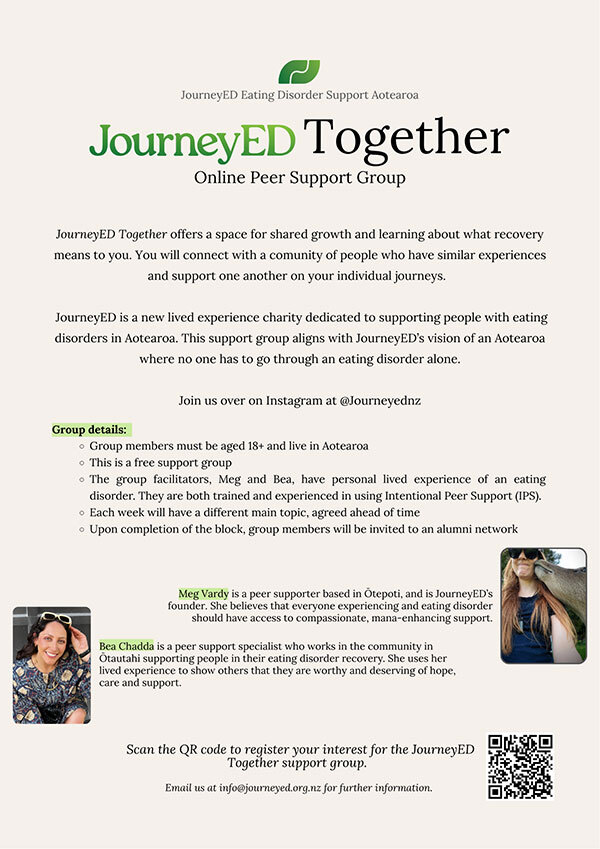
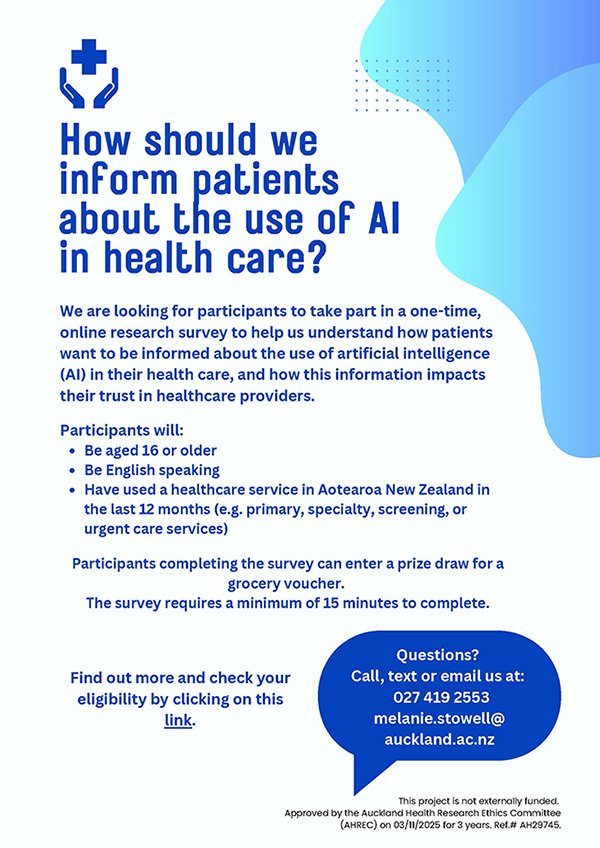
Contact: melanie.stowell@auckland.ac.nz
References
Topic of the Month:
1. Bai, R., Dong, W., Wang, X., Zhang, A., Santomauro, D. F., GBD Eating Disorders Collaborators, Aalruz, H., Abiodun, O., Aboagye, R. G., Aboshanab, K. M., Abreu, L. G., Abu Lila, A. S., Abukhadijah, H. J., Abu-Mahfouz, M. S., Adamu, N. L., Adebiyi, B. O., Adekola, S. A., Adesina, M. A., Adewuyi, H. O., Adhanu, A. K., … Zyoud, S. H. (2026). Global Burden of Anorexia Nervosa and Bulimia Nervosa, 1990 to 2023, With Forecasts to 2050: A Global Burden of Disease Study 2023 Analysis. JAMA Psychiatry, e263457. Advance online publication. https://doi.org/10.1001/jamapsychiatry.2026.3457
2. Griffiths, S., Mond, J. M., Li, Z., Gunatilake, S., Murray, S. B., Sheffield, J., & Touyz, S. (2015). Self-stigma of seeking treatment and being male predict an increased likelihood of having an undiagnosed eating disorder. The International Journal of Eating Disorders, 48, 775–778. https://doi.org/10.1002/eat.22413
3. Paslakis, G. (2026). Eating Disorders in Boys and Men: A Gender-Critical Narrative Review on Recognition, Stigma, and Treatment. The International Journal of Eating Disorders, 59(7), 1397–1402. https://doi.org/10.1002/eat.70085
Tip of the Month:
1. Hornberger, L. L., Lane, M. A., & Committee on Adolescence. (2021). Identification and management of eating disorders in children and adolescents. Pediatrics, 147(1), e2020040279. https://doi.org/10.1542/peds.2020-040279
2. Murray, S. B., Nagata, J. M., Griffiths, S., Calzo, J. P., Brown, T. A., Mitchison, D., Blashill, A. J., & Mond, J. M. (2017). The enigma of male eating disorders: A critical review and synthesis. Clinical Psychology Review, 57, 1–11. https://doi.org/10.1016/j.cpr.2017.08.001
3. Mitchison, D., & Mond, J. (2015). Epidemiology of eating disorders, eating disordered behaviour, and body image disturbance in males: A narrative review. Journal of Eating Disorders, 3, 20. https://doi.org/10.1186/s40337-015-0058-y
4. Dittmer, N., Jacobi, C., & Voderholzer, U. (2018). Compulsive exercise in eating disorders: Proposal for a definition and a clinical assessment. Journal of Eating Disorders, 6, 42. https://doi.org/10.1186/s40337-018-0219-x
5. Griffiths, S., Mond, J. M., Li, Z., Gunatilake, S., Murray, S. B., Sheffield, J., & Touyz, S. (2015). Self-stigma of seeking treatment and being male predict an increased likelihood of having an undiagnosed eating disorder. International Journal of Eating Disorders, 48(6), 775–778. https://doi.org/10.1002/eat.22413