

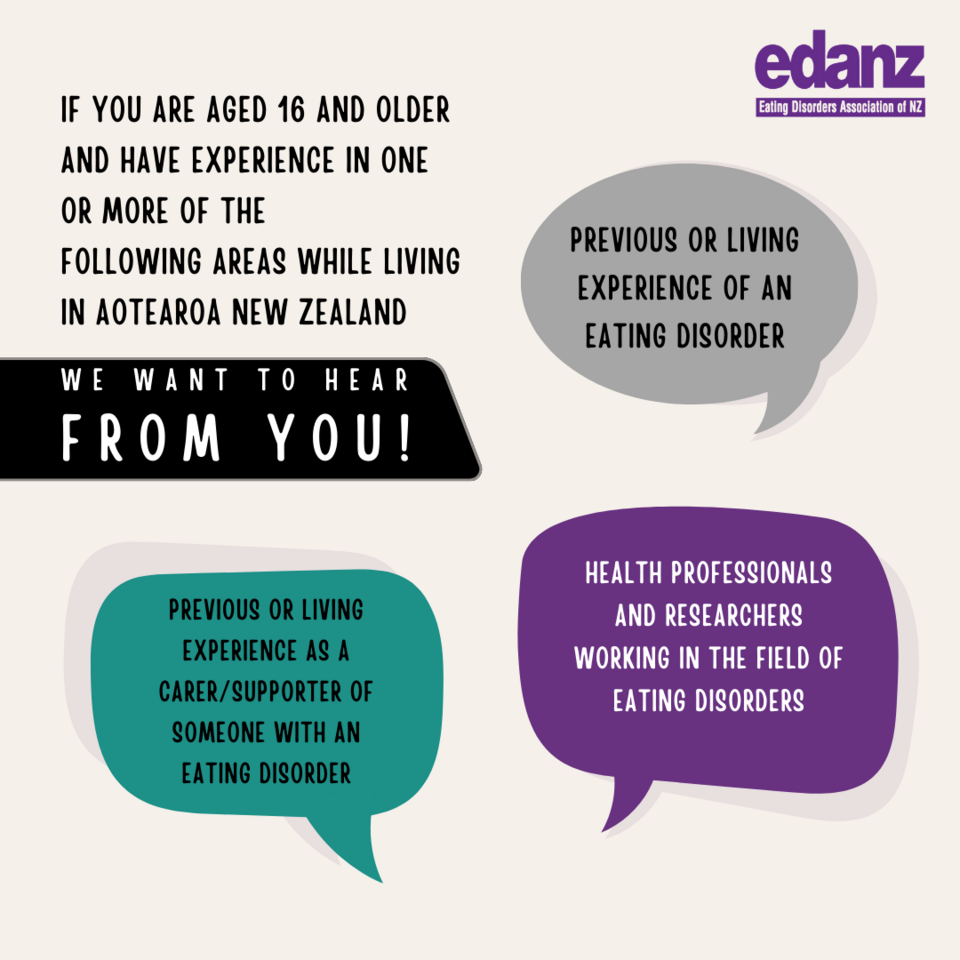
EDANZ is very excited to announce that our co-development survey has launched and we need you to contribute!
This survey is the first of its kind in Aotearoa New Zealand. The outcomes will help us work out what the priorities are for future research into carers and supporters of someone with an eating disorder. We want you to have your say!
If you have any questions, please contact Meg: meg@ed.org.nz
https://forms.office.com/r/kwLYf1CSmF
We acknowledge Joanne Stephenson of Ashburton for her generous bequest to EDANZ for research.
Follow us on social media:



Families tackling adolescent anorexia nervosa: family wellbeing in family-based treatment or other interventions. A scoping review
This scoping review out last month explored the impact of Family-Based Treatment (FBT) on family wellbeing. Across 30 studies, the overall results suggest that there is no difference in family wellbeing between FBT and other treatments. Instead, family wellbeing appeared to either improve or remain the same throughout the treatment journey. This is reassuring for families and clinicians using FBT as a first-line approach.
“It may generate hope for families and clinicians that many studies do find an improvement in family wellbeing over treatment time with families experiencing better communication, fewer family conflicts, less enmeshment, and more adaptability regardless of treatment forms. It is important knowledge for parents and clinicians, that there is no evidence at presence suggesting that FBT, with its active involvement of parents, may harm family wellbeing in general. On the other hand, giving parents an active role does not improve family wellbeing more than other treatments either.”

How to spot the signs of disordered eating in youth: Tips for parents and caregivers
This article, originally published in Canada, provides a brief outline of some of the earliest signs of an eating disorder, and some general recommendations for all parents and caregivers, such as being aware of the signs and parental role-modelling.
“Eating disorders do not discriminate. They can occur in people of any race/ethnicity, age, socioeconomic class or gender. Youth who do not “fit” the stereotype of an eating disorder, especially those from black, indigenous and racialised backgrounds, may face delayed recognition and diagnosis.”

Approaching someone you suspect has an eating disorder
Following on from the previous article, we
wanted to include some advice on approaching the topic an eating disorder with
a loved one. Eating Disorders Victoria provide some great advice for family and
whānau, including being prepared, communicating
honestly and openly, avoiding labelling or judgemental language, and offering
information. One more piece of advice we would recommend is to always remember
your love for one another.
“It may seem challenging, but keep in mind you are doing the best thing for your loved one, and for yourself. There are no right or wrong ways to start this discussion as every situation and person is different, however there are some points to consider.”