

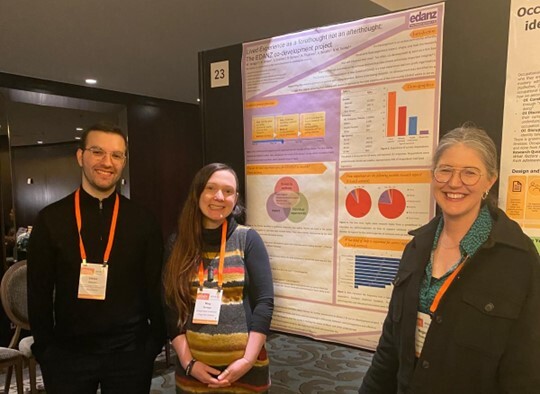
Representatives from the EDANZ research subcommittee presenting our poster “Lived experience as a forethought not an afterthought: The EDANZ co-development project”. From left to right Viktor Gramov, Meg Vardy (Spriggs), Megan Tombs
EDANZ at the ANZAED Conference
It was fantastic to have EDANZ Board members and volunteers at the recent Australia & New Zealand Academy for Eating Disorders (ANZAED) conference in Tāmaki Makaurau Auckland. The conference opened with the launch of He Papakupu: Ngā Māuiui Kai | A Te Reo Māori Glossary for Eating Disorders. It was inspiring to hear about the creation of the glossary, which is designed to be mana enhancing and reflect Māori experiences and worldview. Click here to check it out for yourself.
The next two days were packed full of talks and workshops from researchers, clinicians, and lived-experience representatives. Megan shares her experience here:
"The two standout sessions for me at the conference were both on Peer Support, the Lived-Experience Workforce. The first of these sessions was led by our own Dr Meg Spriggs, co-presenting with Rachel Duck who manages the Peer Mentoring Programme at Eating Disorders Victoria, along with Ruby Winter, the Peer Support Worker at the South Island Eating Disorder Service, based in Christchurch. It was great to hear first-hand how Intentional Peer Support can work in action, as well as contribute our thoughts on how Lived Experience can work alongside clinical teams to support people and their families affected by an Eating Disorder. I enjoyed taking part in the workshop for the next steps in this sector too. We strive for every member of every family affected by an eating disorder to be seen and heard by a workforce who is empathetic and supportive."
EDANZ presented a poster on our co-development project so far. It was great to be able to share our mahi with the community and demonstrate the value of incorporating the community voice into research.
Once again, sincere thanks to those of you who stepped up and answered our call for $$ to enable team members to participate in this extremely worthwhile conference. Your support was amazing.
Health Star Ratings Review: Have your say!
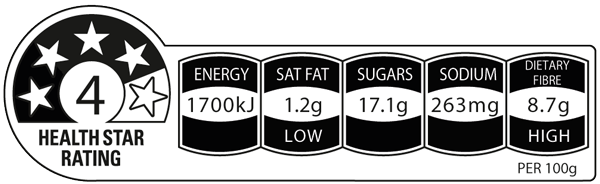
Health Star Ratings are a voluntary front-of-pack labelling system in Aotearoa. However, Health Minister Hon Dr Shane Reti has indicated that a review of Health Star Ratings may be on the cards, with some organisations advocating for mandatory front-of-package labelling and warning labels on foods with “poor nutritional status”.
This short survey has been put together by a group of lived-experience representatives (including EDANZ’s Megan Tombs) to understand how these proposed changes to front-of-package nutritional labels may impact those affected by eating disorders.
We invite you to take part and have your say!


The not-so-secret cost of being superhuman: elite sport’s problem with disordered eating
This piece from the Guardian discusses the pervasiveness of eating disorders in elite athletes and some of the practices and behaviours that sports people are put through to monitor their weight. According to research cited by the International Olympic Committee in 2019, up to 19% of male and 45% of female athletes worldwide demonstrate disordered eating behaviours. Awareness is being raised and change is happening within professional sport to help address the issues.
“In the competitive world of sport, there will always be a push for constant improvement. It is the nature of the environment to continually move forward – records will be broken, new training regimes will produce athletes ever more skilled than before. As sporting bodies begin to acknowledge that the methods behind this pursuit of progress need to be better managed, the first change may be leaving behind the idea of the superhuman, and instead recognising – even embracing – that athletes are simply human.”

What is relative energy deficiency in sport (RED-S)?
Recognised by the International Olympic Committee (IOC) as a syndrome in 2014, RED-S is caused by a prolonged, severe lack of energy, negatively affecting sports performance and health. Symptoms can include low immunity, decreased bone density and disturbed sleep. This article describes RED-S, how to recognise it, treatment, and the culture shift that’s needed to prevent it.
“RED-S is preventable, but true prevention requires a shift in sports culture. Coaches, team doctors, and other sports officials need to prioritize athlete’s health and well-being above all. To this end, Dr. Kathryn Ackerman, director of the Wu Tsai Female Athlete Program, and other specialists have called for the following:
- Increased awareness of the negative effects of low energy availability
- Safe standards for monitoring athletes’ body composition and weight
- Elimination of toxic training environments in which athletes are shamed for the size and shape of their bodies”

How not making the Olympics 'saved' Molly Carlson from an eating disorder
A positive short film about a young female diver, her experience with mental health, and how being open about it helped her. This story offers hope for those living with a sports-related eating disorder and that, with enough voices, the culture change we need is possible.
“Just to feel heard from a coach was so powerful.”