

Five tried and true tips to get through the first month of spring
This article from Psychology Today gives a perspective of a high school student in the States on her journey to recovery and some of the strategies and things she tries to do to help her through the more challenging aspects of spring.
YouTube updates guidelines for eating disorder-related content
As we approach summer, conversations about body image and awareness amplify both in-person and online. Around a year ago, YouTube announced significant updates to help filter out activating content for "at-risk viewers". The platform announced these changes to its policies on eating disorder-related content in response to the growing mental health crisis amongst its users.
The new policies prohibit content that showcases behaviours such as calorie restriction, which can be imitable and harmful to vulnerable viewers. YouTube will also implement age restrictions on videos discussing disordered eating behaviours and will provide mental health resources under relevant content.
These updates are a step towards fostering a safer online environment for those affected by eating disorders, and we encourage our community to check out the tools available to navigate this sensitive season together. You can dive into the details of these updates in this ABC article:
YouTube updates guidelines for eating disorder-related content
The mega-platform made these changes following the publication of many recent research papers indicating increased social media use as a risk factor for Eating Disorders. If you’d like to read these findings check out Mader et al. (2023) here.
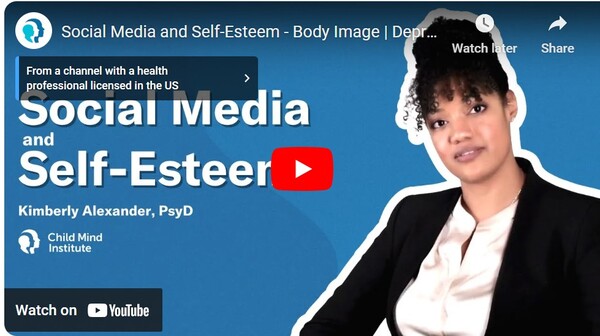
Social media and self-doubt
What can we do when our children are growing up in such a different world than we did; the online world? Here are some great points about social media posts that even some adults forget and this article from the Child Mind Institute reminds us to be compassionate when approaching conversations about social media with our children. It is, after all, their world.
Below is a letter from a courageous young woman talking about her journey to wellness, which is inspiring and insightful to parents on the journey with their loved ones.
What I wish I knew
Recovery is not linear – slip-ups are common, but they are in no way failures, nor are they the end of your recovery journey. I like to think of them as learning steps and experiences, there is always a lesson to be learned in life and it’s about having the mentality to view these situations in a different light.
Eating disorders are psychological illnesses – the physical consequences are just that – consequences. You do not need to be underweight to have an eating disorder. People of all shapes, sizes, and backgrounds suffer from these horrific illnesses and each and every case is as valid as the next.
For some of us, recovery from an eating disorder becomes less about eradicating the voices, and more about turning down the volume of them and giving them less power over the way in which you live your life. For me, I still have disordered thoughts, but I refuse to let the disordered voices in my head have power over my actions any more – this life is mine and I will live it to the best of my abilities that my health allows me.
It is okay to not be okay. Admitting that you need help, and receiving help is not a sign of weakness. I view it as an action of strength and courage. Regular appointments with a variety of healthcare professionals all aided in my repertoire of recovery strategies, and I’m not ashamed to admit that. Every person is unique and individual in the style of recovery which works best for them. In addition to this, going back to professional care once being previously discharged does not mean you have failed. I was discharged from services and at a later date found myself in a different circumstance which required their assistance again – the service was not disappointed in me. I was not disappointed in myself either.
Do not feel bad, or be afraid, of taking time out of work, or schooling, or lessening your load in order to aid in your recovery. In hindsight, taking a year off school and working was probably one of the best things I ever did. It enabled me to put therapy in the forefront of my goals, learning who I was without any study, and was a time when some huge milestones in my recovery were made. Because of this year, I am now able to work part time, as well as study toward my degree at university without compromising the state of both my mental and physical health. Small compromises in the short term that may feel like big sacrifices can often lead to the best long-term outcome.
In addition to this, on a more personal note specific to me, here’s a few things that I do every day to ensure that I keep on an upward trajectory.
Keep a gratitude journal to document the non-number related victories in your day. It can be hard at first, but it does get easier with time. These victories and positives can be as small as the sun shining, a good car journey in traffic, a stranger smiling at you, to something like meeting a friend, getting an award or a good grade or playing a good game in your chosen sport.
Keep in contact with your friends and family. It can be so easy to be reclusive and cut people off due to negative thoughts, but keeping social is a key way of ensuring that your focus is not always internal (which can lead to a lot of ruminating and negative thoughts about yourself). It doesn’t have to be anything big – a favourite drink at a café, going over to a friend’s place for the afternoon, or taking a light walk – but the contact with others can make you feel less alone, and a bit more human when you chat about the random little things going on in your lives. Additionally, they can be amazing sounding walls and motivators when you are feeling down or a bit off – reach out. Most people aren’t used to personally knowing someone with an eating disorder so will not know what to say or do, so you may need to be the initiator of things and let them know what they can do that will help you along your journey.
Never sacrifice the needs of my health for the needs of others. It sounds blunt and some may read this and think it is selfish, but I view it as the highest way of respecting my body, my needs, and myself. After all, how do you expect yourself to be capable of being the best person you can be towards others if you are not practising what you preach and are not good in yourself?
Every day, I tell myself, “I look s**t hot today”. For the most part, this gives me a little chuckle and sets my day off on a light-hearted note. I use it as a way of ensuring that I hear at least one positive remark about myself each day. On some days, this isn’t the case, and I immediately shrug it off, but at least I have tried.
If you have to take away anything from this, let it be these sets of three words that I now choose to live by:
You are enough!
Never give up!
State, not weight!
Megs
A reminder of some of the facts about eating disorders for parents who have spoken to us at EDANZ and are supporting a child with Anorexia Nervosa
- Eating Disorders are not a choice – they are a serious neurobiological illness with strong genetic contribution. Anxiety and/or depression can be a strong fundamental mechanism in an ED.
- FOOD IS MEDICINE – this must be a non-negotiable aspect of your child's life until their weight is restored. Once weight restoration has been achieved other therapies such as CBT-E, DBT, etc may be required and will be effective in bringing full recovery.
- Your child will need to trust those supporting them – try and be CALM, CONSISTENT, CONFIDENT AND COMPASSIONATE, and when necessary, CREATIVE! (fake it when necessary).
- EDANZ promotes Family Based Therapy (FBT) – where you take charge of all your child’s food, drinks, and physical activity, until they are well enough and safe enough in thoughts and behaviours to be able to take over this role again. Their brain is malnourished and therefore not functioning in what we would consider a normal way.
- Your child WILL be distressed when you take control of their food choices and work to limit physical activity. They may shout and kick and scream or have silent tears rolling down their face. Remember, this is the illness fighting you, not them. Don't be put off by resistance. Their own voice is just being drowned out by the ED. Your healthy child is still in there, wanting and needing you to fight. In these hard times, they are saying, "Please do this Mum and Dad. I need you to make me do this."
- Your family and your child’s support people need to become a very tight team. Family support is essential not only in re-feeding and healing but in providing support and guidance beyond weight restoration. They need you all to be 'singing from the same song sheet'. Anorexia Nervosa will look to divide and distract… to cause a bit of conflict over there, so the ED can keep working away over here.
- Understanding the illness. Keep it simple. Your child has restricted and developed a negative energy balance that has 'switched on' the eating disorder. Regular consistent nutrition is needed to restore physical health and interrupt these disordered thoughts and behaviours. FOOD IS THEIR MEDICINE.
- No blame, no shame. You did not cause this. Don't waste any energy looking for what you 'did wrong' or 'could have done differently'. Again, this is a biological brain-based illness. Look forward to having your child well again and back to living the life they deserve.
- Don’t be frightened to discuss the illness with your child. Anosognosia is a symptom of anorexia nervosa (and some other mental illnesses) and means a person does not understand they are unwell. Fortunately, you do understand this, and right now, that's all that matters. Your child will have periods of insight but may also have periods of no insight. This is normal and will lessen as weight restores.
- Helpful phrases: We can see this is so distressing – we are here – we're not stopping until you are well – we love you and are so proud of you – this illness is not your fault – trust us – we are doing this because we can't stand by and watch any longer – you matter more than anything right now – we are here with you – it will be ok....
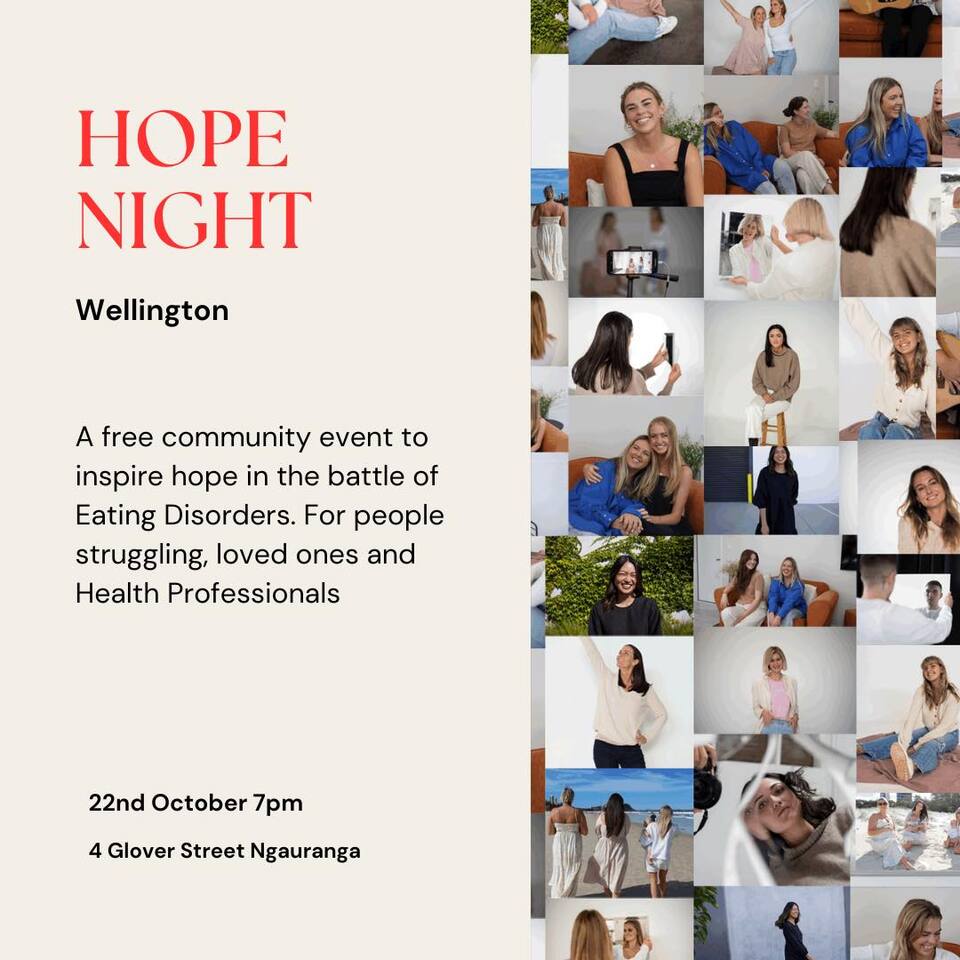
Hope Night Event Wellington
Hope Night is a free community event for those struggling with eating disorders / body image. This event is suitable for family, friends and professionals.
The purpose of the night is to inspire hope and show people that no matter how hard the battle is that full freedom is so possible and worth it.
It is a night full of people sharing their different journeys on a panel and creative arts followed by a Q & A.
Free to attend and no need to RSVP.